
19 APR 2025
Those at the Intersection of the Society: The Nomads of Kutcch - Story of a two year old Maldhari
Author: Dr Dipannita Kaushik, Public Health Expert, Co-Founder DIBHA Foundation
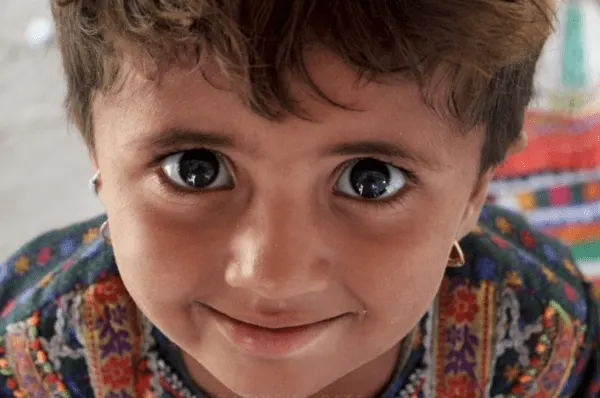
Two year old Sumaiya, (Picture credit: Pratiksha Patel)
Maldharis are nomadic tribes of the greater Rann of Kutcch in Gujarat. They are a local pastoralist community living on the Banni grassland of Kutcch for decades. Kutcch has been facing serious droughts for years and the last few years have been the worst which have made the Maldharis, one among the worst sufferers. Scanty rainfall for two consecutive years has rendered the local grassland barren and groundwater dry. In the absence of adequate local resources and government help, Maldharis had to leave their homes and migrate to faraway places in search of fodder and water for their cattle.
Many such families have travelled more than 400 km, with their buffaloes and cows, to reach near Nal Sarovar in Sanand block of Gujarat. They, adults and children, men and women, boys and girls, are living in abysmal condition in makeshift huts under the open sky.
I had a chance to visit them during my trip to Sanand in March 2019. We were a team of four and had a very close encounter with this physically and socially marginalised community of Gujarat. Maldharis comprises of people from both Hindu and Muslim religion but the group we could meet and interact with, were Muslims.
During the trip I met with this two year old Maldhari girl named Sumaiya. Sumaiya had a mesmerizing look that caught my eye the very first moment I saw her. She had migrated to Sanand town along with her family in October 2018 and was staying in the settlement(no. 8) in Sanand. She is the second child of her parents with an elder sister who is four years old.
This note is about how this little girl's life captivated my mind. She had big black eyes and a heart melting smile. She was the only girl child dressed in a trousers and 'pathani kurta' in the entire settlement. All other girls of her age wore the traditional 'lehenga choli'.
We made so many faces together, giggled and exchanged smiles while my professor and his friend spoke to her father and grandfather. But when I asked her to smile for the camera she just would not.
She was clinging on to her father's 'kurta' as she wanted him to pick her up in his arms. Finally, he sat down on the ground and she jumped into his lap. On talking to him we came to know that they had migrated with her maternal family. He also told us that he was recently diagnosed with typhoid and is taking regular medications for it after consulting a local private practitioner in Sanand. They would not got to the nearby government Primary Health Centre even if it was free as they felt uncomfortable and were mistreated.
Later, I went with Sumaiya to meet her mother, aunts and grandmother. I spoke to her mother who was diagnosed with TB around one and half years ago but didn't take antitubercular treatment because she was pregnant with her third child. Now, the third child is ten months old and she is still not undergoing treatment for TB because she got pregnant for the fourth time, soon after delivering the third daughter. It was disappointing to realise that Sumaiya is soon going to lose her mother to TB due to lack of treatment and nobody could care. Sumaiya's mother was only 28 year old when she was pregnant for the fourth time. She also told me that her ten month old is having intermittent fever, refusing to feed and is lethargic and the nearby doctor upon consultation, asked them to get the baby tested for TB. Even she told me that they only preferred going to private practitioners but that too was troublesome in Sanand as they were new to the place. She told me that little Sumaiya also contracted TB while they were back at home but was treated completely for six months and cured. Sumaiya had already battled TB at two and came out victorious. The mother was extremely disheartened that she was not able to do the same for her ten month old. To this, her sister, Sumaiya's aunt who was sitting next to her jokingly said, 'TB runs in their family'. This age old myth, that has been long disproved still holds true for them. She has been coughing out blood with sputum but she wasn't anaemic yet, according to her blood reports.
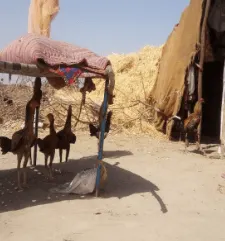
Sumaiya's pets
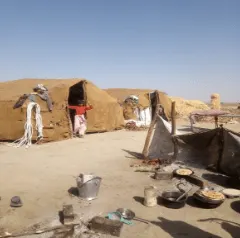
Sumaiya's temporary home
The conversation went on and I asked her about the beautiful piece of nose ring she was wearing. 'It is called a "nath" ', she said and asked me that why don't I wear any jewellery. I laughed and tried to dodge the question as I felt she wouldn't understand that I don't like jewellery even though I am also a 28 year old woman. But her next question was even more difficult for me to answer; she asked me if I was married. This time I told her I am not but that I plan to get married in a year or two. Hearing this, all of them; Sumaiya's mother, her aunt and her grandmother said that in their community it is a sin not to marry off the girl before her first menses come. It is wrong for them to keep an unmarried menstruating girl at home. They also said that they marry within the extended family because marrying into a different family makes it difficult for the girl to adjust into the new culture of the family even if they belong to the same caste.
Further we went on to talk about the temporary residence in the settlement area. We spoke about the inconveniences they have to face due to absence of toilets and bathrooms there. They have proper toilets back at home but here they have to bath in the open with clothes on.
We put up for the night before and were planning to stay over for another few nights in a nearby NGO called Gantar. The NGO people told us that they have tried their best to help the Maldharis in whatever way possible. But the nomads are very reluctant to let their kids attend the school run by the NGO. On inquiring about this to Sumaiya's mother and grandmother, they told me that they are afraid to leave their children alone, as these days kids are being kidnapped and their kidneys are sold off. It was really disheartening to know that those underprivileged kids could not even receive the little comfort and care they could have, from the NGO due to various other possible threats from the world outside. They told me that even back at home they don't send their children to the 'madrassa' because they are very scared. Little Sumaiya will therefore never have the chance go to school or read and write.
Time was limited for us as it was getting darker and we had return to the NGO. I felt a deep emotional connection to this little girl. Deep within I just wished I could bring her along with me and give her all the care she deserves. But that wasn't possible and we told them that we plan to leave. They offered us some refreshments before we left because they believed in being hospitable to their guests. They have so little and yet were so generous. Very rarely do we see such generosity among the urban people. They invited us to visit them in Kutcch. It was an enlightening experience and left remarkable impact on me. Mere reading about them can never bring that much insight.
This was a need assessment survey(informal) and a fund raiser was started for these people immediately after we returned. We could raise sufficient funds to provide aid to these nomads and soon a follow-up team, with doctors and veterinarians went to these settlements to provide relief and care as per the needs.
Sumaiya's life is a perfect example of how our health is beyond the purview of clinical medicine. A shift in focus from clinical medicine to social medicine is the rising need of the hour to attain a higher health status as a country. Today, during the time of this global pandemic, we all have realized the importance of living in a healthy community. An individual's health depends directly or indirectly on his country's health standards which is affected by a range of societal, cultural, geographical, political, and economic factors and whenever there is an intersectionality of these factors, it further increases the hurdle to access equitable quality healthcare for all.
Let's try to remember this time that we can't be healthy in isolation.
